





Why Enterprises Need to Move From Data Visibility to Decision Intelligence
Introduction
Every modern enterprise has more data than ever before.
Business systems capture millions of transactions every day.
ERP platforms record operations.
Supply chain systems track movement.
Finance systems capture financial activity.
Customer platforms store interactions.
Operational systems generate continuous streams of information.
The challenge for most organizations is no longer collecting data.
The challenge is:
How do you turn all that information into better decisions?
Because data alone does not create intelligence.
Reports do not automatically create insight.
Dashboards do not automatically create action.
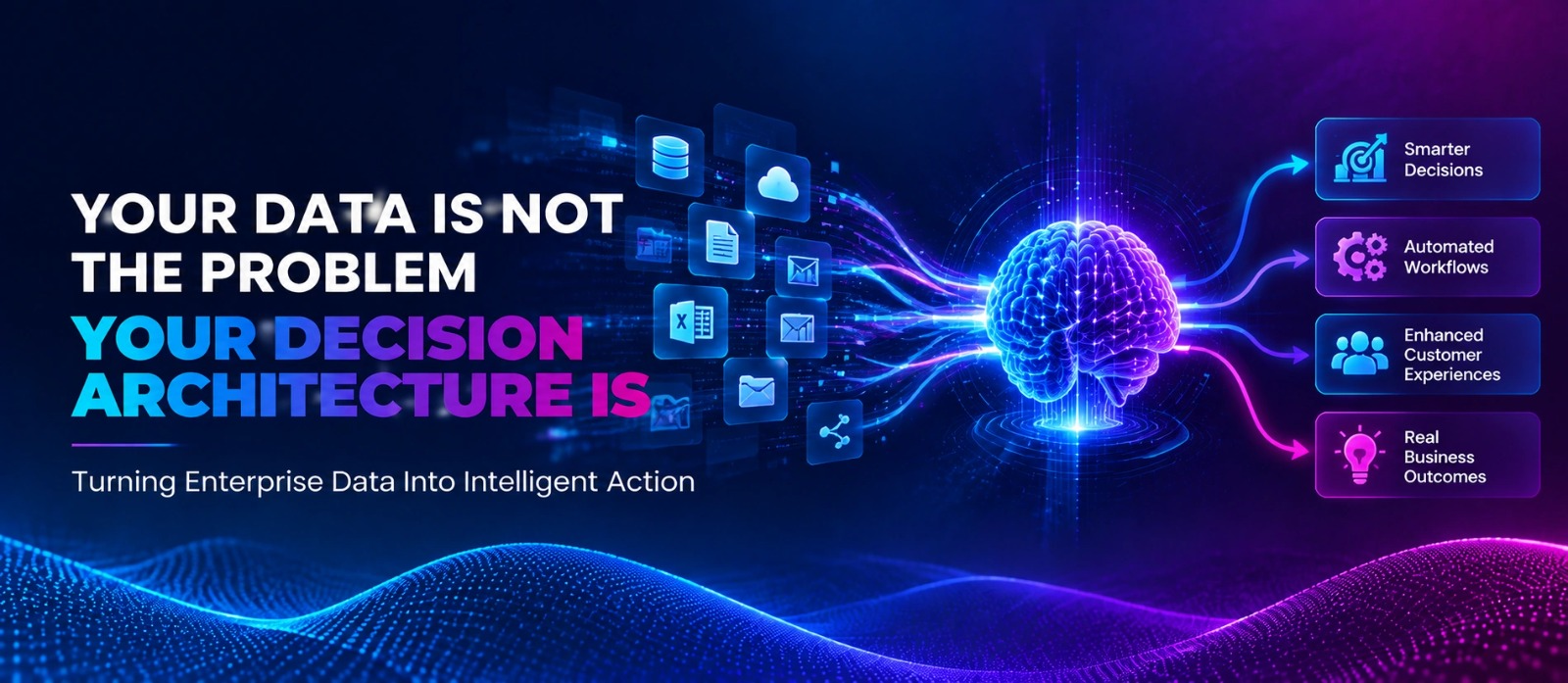
The next evolution of enterprise transformation is moving from simply managing data to building a decision architecture that helps organizations understand situations, evaluate options and act with confidence.
The Data Paradox: More Information, More Complexity
Organizations have invested heavily in digital platforms.
However, many still experience challenges such as:
- Information spread across multiple systems
- Different departments working with different versions of data
- Manual reporting processes
- Delayed decision-making
- Limited visibility into business impact
The problem is not a lack of information.
The problem is connecting information with the context required to make decisions.
A supply chain leader does not only need to know that inventory is low.
They need to understand:
- Why is inventory low?
- What customer commitments are affected?
- Are suppliers able to respond?
- What alternatives exist?
- What action should happen next?
That requires more than data.
It requires intelligence.
From Data Management to Decision Intelligence
Traditional enterprise systems have been designed primarily to record and process transactions.
They answer questions such as:
- What happened?
- When did it happen?
- Where did it happen?
Modern enterprises need to answer additional questions:
- Why did it happen?
- What could happen next?
- What options are available?
- What is the best action?
This is the shift from:
Data Visibility
Understanding what is happening.
To:
Decision Intelligence
Understanding what should happen next.
Why Enterprise Context Matters
Artificial Intelligence becomes valuable when it understands the business environment around the data.
A number by itself has limited meaning.
Business context gives that number value.
For example:
A delayed shipment is not only a logistics issue.
It may impact:
- Customer commitments
- Production schedules
- Revenue expectations
- Supplier relationships
- Business priorities
An intelligent enterprise connects these relationships.
It understands not only the data point but also the business consequence.
The Role of Connected Enterprise Systems
Enterprise intelligence requires connected foundations.
Important business information often exists across:
- ERP systems
- SAP environments
- Supply chain platforms
- Finance applications
- Customer systems
- Operational databases
- Sustainability platforms
When systems remain disconnected, organizations spend time collecting and reconciling information instead of acting on it.
A connected architecture allows businesses to move from:
System Information
↓
Business Understanding
↓
Intelligent Recommendation
↓
Action
How AI Changes Enterprise Decision-Making
AI introduces a new capability:
The ability to analyze complex situations and support decisions at scale.
Examples:
Supply Chain Intelligence
AI can evaluate:
- Inventory levels
- Supplier commitments
- Demand changes
- Production constraints
- Logistics conditions
and help identify risks before they become disruptions.
Intelligent Procurement
AI can analyze:
- Requirements
- Available inventory
- Supplier options
- Lead times
- Cost considerations
to support better procurement decisions.
Finance Intelligence
AI can support:
- Document processing
- Exception identification
- Transaction analysis
- Workflow automation
allowing finance teams to focus on higher-value activities.
ESG Intelligence
AI can help organizations understand:
- Sustainability performance
- Emissions information
- Reporting requirements
- Emerging risks
and transform ESG data into actionable intelligence.
The Future Enterprise: Intelligence Connected to Action
The intelligent enterprise is not created by adding more dashboards.
It is created by connecting:
Data
Reliable information from across the organization.
↓
Intelligence
The ability to understand patterns, risks and opportunities.
↓
Decisions
Recommendations supported by business context.
↓
Execution
Actions performed through connected workflows and systems.
Building a Strong Decision Architecture
Organizations looking to become more intelligent should focus on four foundations.
1. Trusted Data
AI decisions depend on accurate and reliable information.
Organizations need clear ownership, quality controls and structured data practices.
2. Connected Systems
Business processes rarely exist in one application.
Integration between enterprise platforms enables a complete understanding of business situations.
3. Intelligent Workflows
The goal is not only identifying insights.
The goal is connecting insights with actions.
4. Responsible Governance
Enterprise intelligence requires:
- Security
- Access control
- Transparency
- Human oversight
- Monitoring
Trust is essential for adoption.
Moving Beyond Reports
Reports tell organizations what happened.
Dashboards help visualize information.
But the next generation of enterprise technology must help answer:
What should we do next?
That is the difference between information and intelligence.
Conclusion
The future of enterprise transformation is not about collecting more data.
Organizations already have enormous amounts of information.
The opportunity is creating the architecture that connects data, intelligence, decisions and execution.
Businesses that successfully build this foundation will be able to respond faster, operate smarter and make decisions with greater confidence.
The intelligent enterprise is not defined by how much data it owns.
It is defined by how effectively it turns information into action.
Better data creates visibility.
Better decision architecture creates business value.
Recent Articles
-
How Enterprises Can Move From Compliance Reporting to S...
 By Atominos Team • Sep 24, 2026
-
Why Enterprises Need to Move From Data Visibility to De...
By Atominos Team • Sep 24, 2026
-
From AI Pilots to Enterprise Execution: Why Businesses ...
By Atominos Team • Sep 24, 2026